Showing posts with label ponderings. Show all posts

Friday, October 21, 2022

Fall Trip Data & Summary

We wrapped up our 35-day fall trip and are home safe and sound. There were many good things on the trip:
- No issues with our Winnebago Travato - all systems performed as designed
- I'm lucky to have such a great travel partner (Elena) as we celebrated our 32nd wedding anniversary during the trip
- I'm also lucky to have the best dog in the world (Bebop) - she is a great companion and traveler
- We had many great adventures and only a couple skinned knees to show for it

On the downside:
- We both got COVID at the start of week #4, after successfully avoiding it for 2 1/2 years. It was likely caught during a grocery store stop - one of our few indoor interactions with people. We just modified our schedule for reduced hiking intensity and kept on rolling.

DATA
Miles Driven: 4,225 miles
Average miles/day: 121

Time Driving: 100 hours

Avg Speed: 41 mph

MPG: 17.1 (vehicle calc); 16.2 (actual)

Gas Used:  257.5 gallons, average of 7.4 gallons/day

Gas Cost: $961 ($27/day) - avg of $3.73/gallon

Campground Cost: $894 (avg $24/day):
(12 state parks, 9 free boondocking, 5 national parks, 5 private campgrounds, 2 tribal campgrounds, 1 city park, and 1 forest service campground)

So many highlights on this trip. We have quite a few blogs posted, but here are a few favorites:
- The Kanarra Falls hike was probably our favorite new adventure. Blog link

The upper falls on Kanarra Creek

- Little Wild Horse Canyon slot canyon hike was right up there in the new adventure ranking. Blog link (by Bebop)

Little Wild Horse Slot Canyon
- We've been to several sections of Antelope Canyon, so we visited a different section - Antelope Canyon X. Blog link (last section).

Antelope Canyon X

- And Canyon de Chelly was interesting - made more so by a fierce rainstorm and flood while we were in the canyon. Blog link.

Spider Rock in Canyon de Chelly

The other blogs, with more photos, are all posted here: https://westbrooktravel.blogspot.com

Favorite photo from the trip - Grand Canyon North Rim

Our Trip Route

We have had our Winnebago Travato for 15 months and have travelled for 141 days and almost 20,000 miles total.

Best,

Paul

Saturday, October 15, 2022

The End of a Long Love Affair . . . Or Not

It was a late September day in 1991 when I first saw her. Her beauty was boundless and I was immediately captivated. I was in town for a jazz festival with my wife, as we were about to celebrate our 1st wedding anniversary with a hike into the Grand Canyon a few days later. But there she was - the town of Sedona, AZ. I couldn’t believe people were allowed to live here - as if people were allowed to live in a national park. The layers of rock color, the green of the juniper trees, the deep blue sky, and the trickle of Oak Creek. I was captivated.

I thought about the town many times, and we came through on vacation a time or two over the years. In 2009, I began to think about possible future retirement locations. The Sedona prices had gone nuts in 2007 and 2008, but the real estate market crash was starting to bring prices back down to reasonable levels. I booked a flight and came out to look around. We would come out twice a year for the next decade and hike the many trails and look at land parcels. I made offers on a few over the years, and several times my offers were accepted. Each time, I would find something during the discovery phase that caused me to back out. It had to be the perfect parcel at the perfect price, and we were in no rush.

I liked that the town was surrounded by national forest, so the growth was bounded. They are a dark sky friendly town. The population is around 10,000 people, and the large number of visitors meant that the town had more grocery stores, restaurants, and entertainment options than most towns of that modest size. The climate was good at about 4,400 feet in elevation - not too hot or too cold. And it was beautiful in every direction I looked.

The more I studied the town and the workings, the more concerned I became. The place seemed to be run by the Chamber of Commerce. Everything was designed to bring more tourists (money), which meant traffic and infrastructure woes. However, the city had a ban on short term rentals to try and make sure it was a town of people who owned, lived there, and were active in the community. Then, in 2016 the Republican led state government passed a law over-ridding the ability for local jurisdictions to regular short term rentals across the state. Sedona started seeing investors pouring in to make a buck. Once quiet neighborhoods now had short term renter traffic. A sense of community was being lost. Then investors started buying lots and building massive houses just to rent out many rooms. Local people who worked there could no longer find a place to live - they have to commute to towns 20 miles away. Greed was destroying the beauty and charm, as seems to be the case so often anymore. 

We made our final trip out in October 2019 and decided another paradise had been lost. I tried to quit dreaming of buying land and building a sustainable home here. I told Elena once that looking at some difficult build lots in Sedona is like looking at a gorgeous woman who you know is going to be nothing but trouble, but not being able to look away for long. Prices started going even crazier during the pandemic and land was flipping in months for double the money - just like during the crazy times of 2007. That helped blunt my enthusiasm a bit.
 
The other challenge is that we have such a nice setup in Fairview, TX. We have 2.2 acres of native woods with our house hidden in the middle. We have some of the kindest, nicest neighbors you could ever want. Not only that, but we have plenty of elbow room on our street, but are only a few miles from almost any amenity you could want. It would be easier to make the move if we lived in a regular old house on a regular old street, or in a decaying area. Our current bar is set very high. 

We hadn’t planned to come to Sedona on our current road trip, but both caching COVID made us scale back on some other big hikes we had planned. Elena suggested we route through Sedona for a couple of days. The things we loved are still there - the rocks, the forest, the creek, the dark skies, the climate. But the trailheads were overloaded with cars and traffic was slow in every direction. We noted, as before, there seems to be a few distinct tourist categories here. One is the nature lovers like us who come, hike, and try to leave no trace. We meet a lot of people out on the trails who are similar - both local people and visitors. There is another group who spends most of their time shopping in the stores and galleries, or eating at the high-end restaurants. There is another trendy group who are out striking the same Instagram pose along every trail and overlook. Then there are the people who come to a quiet, beautiful place and seem to say, “What’s the best way to destroy this?”  They rent the loud ATVs and drive them all over, or jump in one of the many Jeep tours and mark the red rocks black from their tires and belch fumes and noise into the air.

I find myself looking at lots again and dreaming of a little sustainable solar home with great views and easy access to hiking trails. This morning we found three trails that are beautiful, but not very crowded. Bebop really enjoyed hiking, despite the low count of trailside lizards. We drove past some trailheads with over a hundred cars spilling out to park along the roadway. Out on the trails, we remembered all the things we love here. Elena was busy looking up geology on her Rockd app. We noticed that the gem and mineral show was at the Sedona High School, so we dropped Elena off there for a while. On our way back to our campground, it took us about 30 minutes to drive 1.5 miles in the heavy traffic. It’s a town of major pluses and major minuses. It’s fun to dream, but it’s also nice to return home to the wonderful reality we already have. Will we end up here someday? That is unanswerable at this time. Here are a few photos from today before the rain moved in. You would have to try really hard to take a bad photo here.
Up on Doe Mountain

Bebop on Doe Mountain
Paul & Bebop on Doe Mountain
Bebop descending Doe Mountain
At the end of Fay Canyon looking back out
Bebop on the Secret Slickrock Trail
Reflecting in front of Cathedral Rock on the Secret Slickrock
Elena admires the vista

- Paul


Thursday, August 12, 2021

Fractal Reality

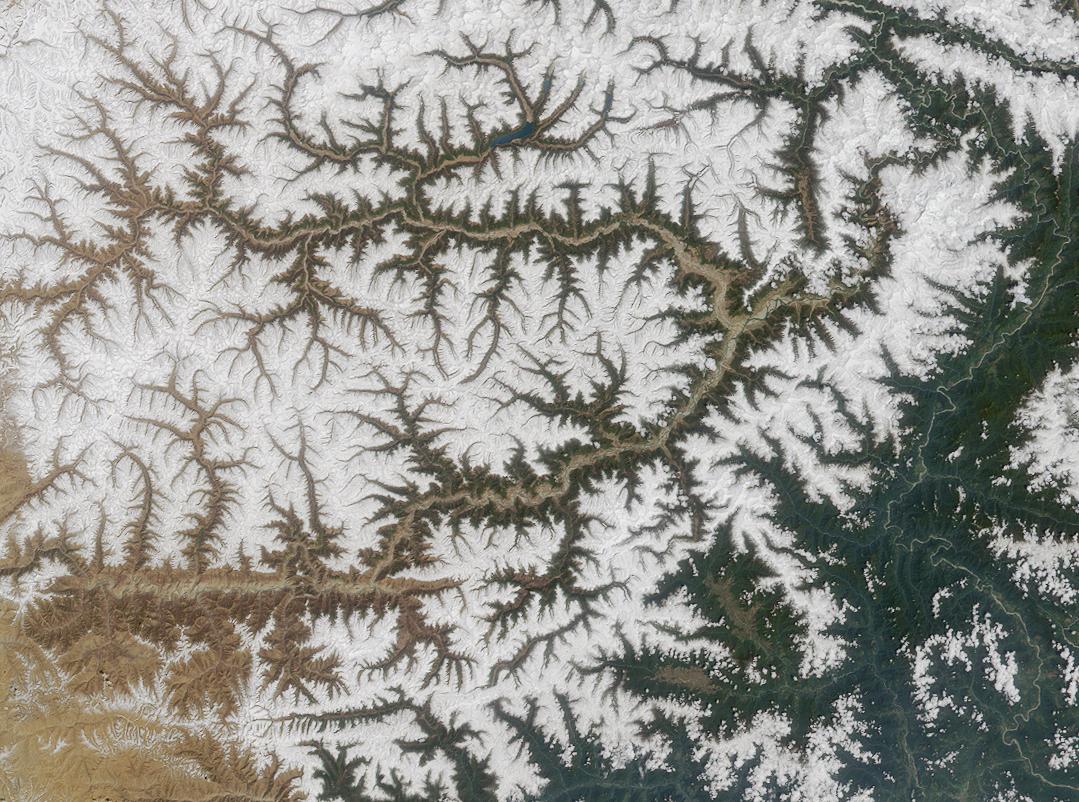
Have you ever noticed how often a tiny new stream has the same folds, bends and miniature cliffsides as a mature canyon? Or the way each stretch of beach echoes the inlets, outlets, peninsulas and tidal pools of the larger coastline?

Reality is fractal. Even if you don't understand the formula for the Mandlebrot Set (I don't), you can still recognize the mathematical beauty in a Romanesco cauliflower. (Follow the link in the picture caption to read new research into how a cauliflower grows like this.)

http://www.sci-news.com/biology/fractal-romanesco-cauliflowers-09853.html
image by Marc Pascual

The fact that fractals are so pervasive seems to me to indicate that there's a message to be heard, beyond the truism that everything is math. 

I started thinking about another truism, or proverb, that "how you live your days is how you live your life." Or "take care of the pennies, and the dollars will take care of themselves." Our small interactions tend to repeat, to cycle, to build upon themselves. Ultimately, we end up where my mother wisely told me: People see in the world what they bring to it. Someone who is kind and friendly will perceive that others are kind and friendly. A con man will assume everyone is out to con him. 

This isn't rocket science, though it may be math. 

If you like the math, though, or canyons, here's a fun rabbit hole to run down:   http://paulbourke.net/fractals/grandcanyon/

So, given the fractal nature of reality, and also given that the only thing we can control is ourselves, I'm going to try to pay more attention to the tiny new streams of my habits before they become a Grand Canyon of sloth. 


Happy hiking, and may all your fractals be beautiful -- 

Elena


Wednesday, August 11, 2021

Time Frozen, Folded, Slipped and Pummeled

I fell in love with rocks for their beauty: the way they catch and throw light, the shapes of mineral crystals, their different weights and textures. But what keeps me captivated is what rocks teach us about time.

In Glacier National Park, 2016

In geology, a million years is a rounding error. Humans are as inconsequential as gnats, here and (soon enough) gone. The basement rocks visible at the bottom of the Grand Canyon are approximately 1.8 billion years old, almost half the age of the earth. Because of a missing section called "the Great Unconformity," you can't just lay out the vertical rocks on a horizontal timeline; however, the rocks laid down during the Precambrian add to more than 12,500 feet in depth, not counting the basement rocks. The Paleozoic rocks, dating back to the Cambrian era 525 million years ago, add up to more than 3,500 feet in depth. The most recent layers  weathered away as the canyon was forming, so the rocks at the top are estimated to be 250-270 million years old. (See https://www.nps.gov/articles/age-of-rocks-in-grand-canyon.htm for more.)

During those not-quite-two billion years, the Colorado Plateau was taking a long journey around the globe, below and above the equator, as part of Pangaea and then broken free, below oceans and above them, as beach and as desert dunes. These rocks have been lifted, folded, squeezed and sometimes melted. They have been subject to forces we can barely imagine.

For comparison, modern humans appeared no more than a few hundred thousand years ago, and only developed language about 50,000 years ago. If all the missing rock layers from the last 270 million years still existed in the Grand Canyon, human history would represent a thin layer of dust on the top.

Kind of puts your office deadlines into perspective, doesn't it? 


Not the Grand Canyon - sedimentary layers visible in Utah

More than 99% of all species that have ever lived on Earth are now extinct. Someday humans will be too, although whether we die out because we can't adapt to the damage we have wrought, or instead we evolve into some presently unimaginable form, we can't know. And the Earth doesn't care. Tectonic plates will continue to bang into one another, or rift apart. Mountains will be shoved up and worn down, grain by grain. Silicon dioxide will continue to form quartz, which makes hexagonal crystals whether or not we are here to judge them beautiful.

If I get too caught up in politics, or office work, or some puny individual concern, it helps to remember that all of it will pass away. For all our worry and upset and pain and judgment, time makes dust of us all. The best response is just to be kind, today, and let all the rest flow by like a river, carving its way through rock.  


-Elena


Tuesday, August 3, 2021

What if the earth loved you back?

That question comes from Robin Wall Kimmerer, author of Braiding Sweetgrass. She asked it to a group of graduate environmental students who were in the program because they felt profound love and devotion to the natural world. But when she asked, "Do you think the earth loves you back?" they got twitchy, unwilling to feel their love for the earth was returned.

Kimmerer is a biologist and a member of the Citizen Potawatomi Nation, and her book has been one of my companions on this journey we are taking. She writes about many different aspects of her experience, tied together with a worldview founded on graditude and relationship, rather than profit, selfishness and isolation. 


https://bookshop.org/books/braiding-sweetgrass-3e12996d-ea04-4dd2-b9a9-04cfd82f361f/9781571313560

In a previous blog, Paul told about the stories and lessons Don Fish, a member of the Blackfeet Nation, told us at the Two Medicine Campground. Fish, like Kimmerer, grounds his experience of the world in gratitude and relationship. Starting from this viewpoint changes everything. 

Kimmerer writes about the Honorable Harvest, which is similar to the idea of sustainability but arises from an ethic of honoring the gifts given by the earth, rather than the strictly practical consideration of eking out maximum returns indefinitely. She tells a story to illustrate: Tribes in the Great Lakes have always harvested wild rice. Early European settlers saw their harvesting methods as wasteful, evidence of laziness. But that wasn't it. The tribe follows a principle of never taking more than half of any gift the earth offers, in order to leave some to feed other beings and to seed next year's crop. One recent visitor wanted to learn more about Native ways of being and accompanied a family out on the lake to harvest rice. He saw that about half the rice spilled into the lake, and -- being a good young engineer -- sketched out a device that could capture 85% of the rice instead. The family thanked him for the idea, but wasn't interested. "Do you think we're the only ones who like rice?" they asked.

On our trip, we've been spending more of our hours touching earth than usual, but we're still driving a gasoline-fueled, air-conditioned van and eating packaged food. Paul and I may have a lower overall environmental impact than some, but we are far from being harmless. What would it take for us, and for the U.S. as a whole, to pivot to a life built on gratitude, respect and relationship? And what would it change? 

The U.S. has a lot of challenges to overcome in the next seven generations, climate change being potentially the most devastating. If we don't implement solutions now, widespread destruction will force painful solutions upon us. Dabbling around the edges won't do it. Easy technological fixes won't do it. What the earth needs is for us to treat all forms of life, all the different ecological niches, our plant brothers as well as our animal sisters, as our relations -- to respect, to listen to, to learn from, and to meet every morning with not just gratitude, but love. 

Red-tailed hawk in Fairview

--Elena